Factotum
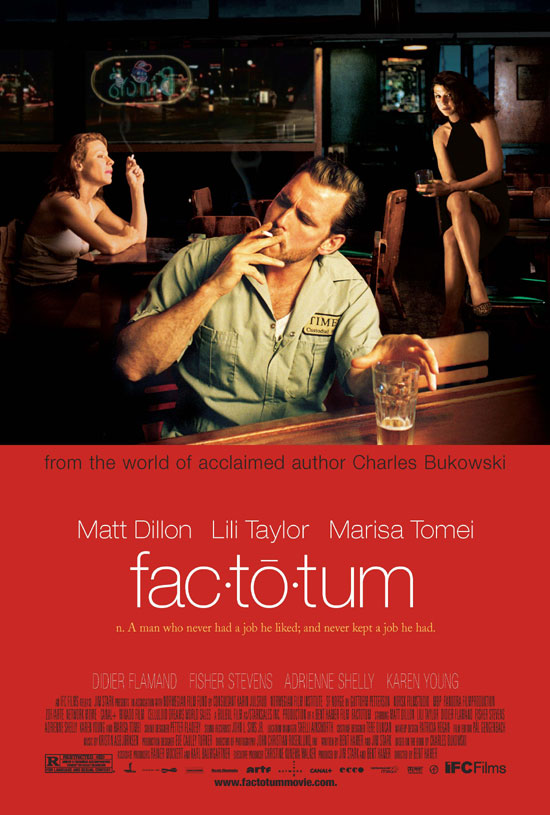
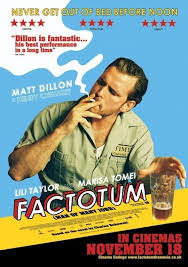
This was the official website for the 2006 film, Factorum.
The content below is from the site's 2006 archived pages and other outside review sources.
Jim Emerson August 24, 2006
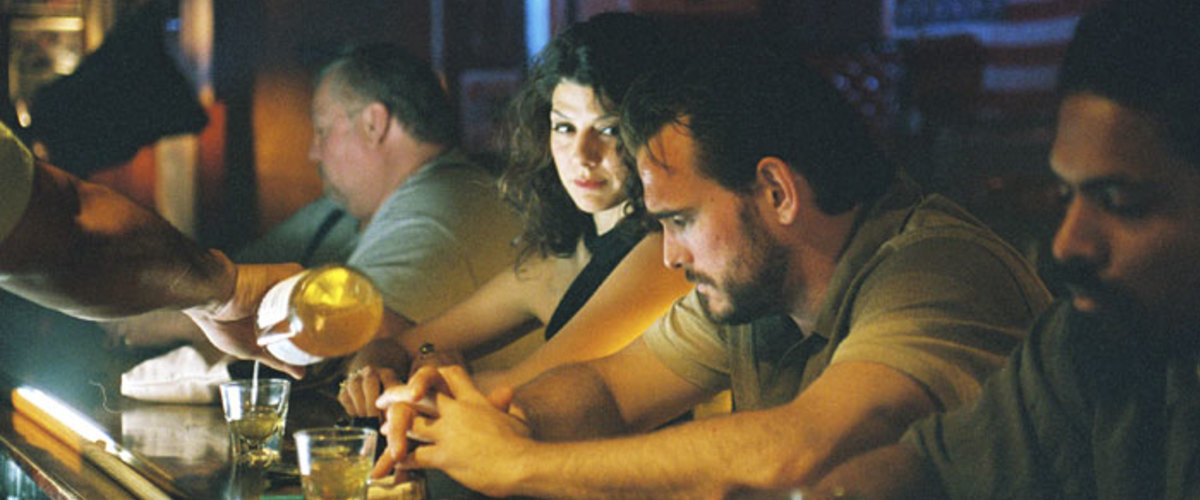
An egg plops into a sweaty glass of beer, gripped by a gnarled, papery hand with chipped fingernails. In the background, a man sits immobile in faded light, lost in a pale fog. Perched next to the old guy at the bar is Henry Chinaski (Matt Dillon), who's just lost -- or quit -- another job, though it hasn't been made official yet. The stewed codger says to him: "I've probably slept longer than you've lived."
Probably. But, soaked in spirits, most of that sleep isn't likely to have given him much rest. Henry -- the alter ego of German-American writer/drinker/poet Charles Bukowski -- is still in his 30s, is only partly pickled, an alcoholic on training wheels. His constitution hasn't yet adapted to process the amount of liquor he consumes. So, he still pukes when he wakes up in the morning (or the afternoon) of the night before. He stumbles out of bed to the toilet, vomits and opens a beer. His girlfriend follows. She staggers, vomits, and lights a cigarette. Rise and shine.
"Factotum," directed by Bent Hamer, is a picaresque Bukowski primer, adapted by Hamer and Jim Stark from the title novel and a handful of stories about the poetically debauched author's primary subjects: drinking, writing, women and gambling. But mostly drinking. On his journey to cult fame, he takes (very, very briefly) a series of jobs that help him get from one drink to the next: iceman, taxi driver, brakeshoe stockboy, pickle sorter, whatever it takes between stints on unemployment. Jobs, people, paydays -- they all float in and out of Henry's life without much consequence. My dictionary says the title word means "an employee ... who serves in a wide range of capacities," and that sounds about right.
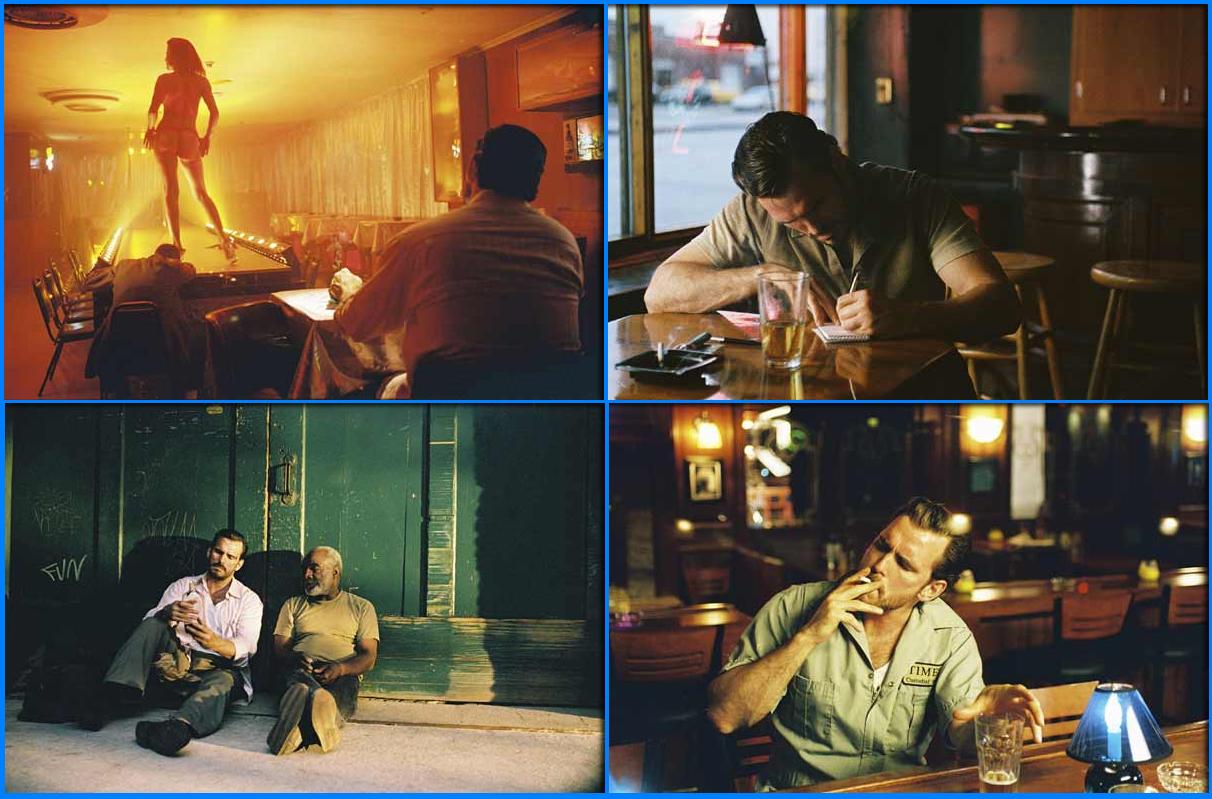
This movie may think it's about a man who boozes and works fitfully while pursuing his muse as a writer, but that's not the way it plays. "Factotum" is about a man who rarely works and occasionally writes, but only as fleeting distractions from his boozing. Trying to pick up his paycheck for his less-than-one-day stint as a lobby statue duster, Henry explains: "All I want to do is get my check and get drunk. Now, that may not sound noble, but it's my choice." Such is his credo for survival in the land of well scotch and the home of the minimum wage.
Dillon is a fine actor (at his best in the even dopier "Drugstore Cowboy"), but he doesn't seem quite slovenly or bloated or stinky or dissipated enough for this role. He's not romantic or bitter or disillusioned, just kind of wan and inert. His performance kept reminding me of somebody. Maybe it was Bukowski, or the other Henry Chinaski (Mickey Rourke in Barbet Schroeder's floridly Bukowskian "Barfly"). But I'm afraid it seemed more like a series of impressions -- of Christian Slater, or Bruce Springsteen, or Marlon Brando -- or all of them at once, mixed up like a slightly sweet cocktail made with cheap liquor.
The standout performances are from the women Henry gets to take him home -- Jan (Lili Taylor) and Laura (Marisa Tomei). Both are needy, but also know exactly what they want from Henry. And he pretty much lets them have it.
"Barfly" made evocative use of the tawdry old drinking joints in the no man's land along 3rd and 6th streets between downtown Los Angeles and La Cienega Blvd. You could smell the rot (and the rot gut) in the air, the aroma of hung-over days and dissolute nights. Because "Factotum" takes place in Minnesota (shot in and around Minneapolis-St. Paul), it seems so much cleaner, tamer, nicer than the 100-proof hard stuff.
Bukowski is one of those writers who can seem perversely, solipsistically romantic and glamorous, in a seedy-underbelly kind of way that's particularly attractive to surly teenagers and alienated college students who are aching to get some grit under their nails. He can even sound like a beery motivational speaker (or a Nike ad): "If you're going to try, go all the way. There is no other feeling like that. You will be alone with the gods. And the nights will flame with fire. You will ride life straight to perfect laughter. It's the only good fight there is."
But it's easy (and may even be necessary) to outgrow Bukowski's self-mythologizing lowlife pose/prose, just as it is to move beyond Judy Blume or Tom Robbins. How many people still read Bukowski in their 30s, 40s and beyond? I sometimes imagine him as a case of arrested development -- as if the Tom Waits of the '70s, who made boozy atmospheric records like 'Closing Time,' 'Nighthawks at the Diner,' and 'Small Change' had never developed the richer, more mature and poetic music of 'Rain Dogs,' 'Alice' and 'Blood Money.'
I Almost 20 years after "Barfly," "Factotum" mostly feels... unnecessary. It doesn't have anything to reveal about Bukowski's art or his life -- nothing like David Cronenberg's illuminating and imaginative vision for fusing William S. Burroughs' biography with his fiction in "Naked Lunch." "Factotum" is just slumming.
As a single father, the last few years have been defined almost entirely by me seeking treatment for my daughter’s eating disorder - it didn’t just consume her life — it consumed mine, too. Every conversation, every decision, every moment at home seemed to orbit food, control, fear, and vigilance. When she finally came home, I found myself desperate to help her reconnect with something that felt normal, something that wasn’t framed by monitoring, appointments, or anxiety.
So one night, instead of me choosing something “safe,” I asked her what she wanted to watch. Without hesitation, she said Factotum. She’s always been a big fan of Matt Dillon, and this was a film she’d wanted to see for a long time.
I’ll admit, I was nervous. On paper, Factotum sounded dark — alcoholism, drift, self-destruction — and my instinct as a parent who has spent years bracing for triggers was to steer us elsewhere. But her enthusiasm won out, and I’m incredibly glad it did.
What struck me most wasn’t the darkness I feared, but the quietness of the film. It’s restrained, understated, almost gentle in its pacing. Watching it together didn’t feel like stepping into chaos — it felt like sharing space. For 90 minutes, we weren’t talking about food, weight, recovery plans, or warning signs. We were just watching a movie. Together. Like a normal father and daughter.
That may sound small, but for families who’ve lived under the shadow of an eating disorder, it’s enormous.
Factotum unexpectedly became a marker of progress — not because of its subject matter, but because of the experience of sharing it. It reminded me that recovery isn’t just about avoiding what’s dangerous; it’s also about rediscovering ordinary pleasures and trust. Letting her choose. Letting myself not overcorrect. Letting us exist in the same room without crisis management.
I’m grateful this film — and the thoughtful, understated way it presents its story — helped give us that moment. It wasn’t therapy. It wasn’t a lesson. It was just a movie night. And right now, that feels like a real victory. Harry Stiles
+++
On the Barstool Again, With One for His Muse, in ‘Factotum’
FACTOTUM
- NYT Critics’ Pics
- Directed by: Bent Hamer
- Comedy/Drama: Romance
- R
- 1h 34m
MANOHLA DARGIS AUG. 18, 2006
FOR years the boozy, beautiful world of Charles Bukowski has proved catnip to European filmmakers and a few American actors happy to go along for the rough ride: Ben Gazzara, Mickey Rourke and now Matt Dillon. Bukowski’s own story (his parents moved to Los Angeles from Germany when he was 3) clearly holds attraction for certain creative types, as do all his tales of ordinary madness. That many of those stories take place in Los Angeles may be particularly seductive, since few images telegraph the paradox of the American dream better than a drunk passed out in the shadow of Hollywood.
Hollywood, as sign or guiding principle, is nowhere to be found in “Factotum, ” and there isn’t a palm tree in sight. Shot in a seedy, forlorn Minneapolis, far from that city’s green-canopied streets and Prairie School architecture, the film was directed by the wonderfully named Bent Hamer, a Norwegian whose earlier features include the deadpan comedy Kitchen Stories.” Working with the producer Jim Stark, Mr. Hamer adapted the screenplay from the 1975 novel of the same title, with snippets from three other, more characteristically Bukowskian sounding volumes: “The Days Run Away Like Wild Horses Over the Hills” and the posthumous “What Matters Most Is How Well You Walk Through the Fire” and “The Captain Is Out to Lunch and the Sailors Have Taken Over the Ship.”
Published when Bukowski was in his mid-50’s and starting to reach a wider readership, “Factotum” presents the age-old struggle of man against mediocrity. Henry Chinaski (Mr. Dillon), Bukowski’s familiar alter ego, is the heroic survivor of countless benders, brawls, rejection slips, crazy women and soul-killing, mind-deadening jobs. Or, as he puts it so nicely in the novel: “How in the hell could a man enjoy being awakened at 6:30 a.m. by an alarm clock, leap out of bed, dress, force-feed” — there is, naturally, a scatological dimension to this list — “brush teeth and hair, and fight traffic to get to a place where essentially you made lots of money for somebody else and were asked to be grateful for the opportunity to do so?”
In “Factotum” Henry answers this most reasonable question mostly by trying to avoid working, or at least working too hard, for other people. (Bukowski himself toiled for the Postal Service for more than a decade.) To that end, he takes a succession of menial jobs that require him to polish the vainglorious décor of a newspaper building (he holds out hope, briefly, for a job as a reporter), jackhammer ice and sort pickles. He does all of this with degrees of competency and just enough interest to keep him from collapsing into a stupor, though on occasion he does drop into the nearest bar. There, in a flood of alcohol, he casts a bloodshot eye on the adjoining flotsam and jetsam, taking notes on the human condition.
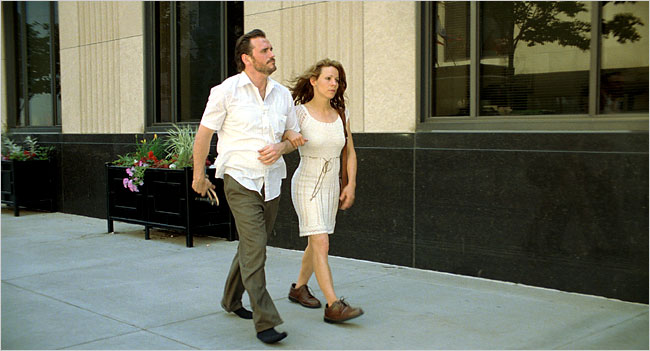
Matt Dillon and Lili Taylor in “Factotum.” CreditMark Higashino/IFC Films
Of course Bukowski-Chinaski was always working, even when he could barely hold down a job, sending out manuscripts and collecting, for many lean years, rejection notices. In “Factotum” Mr. Hamer shows us Henry coiled over a dimly lighted table, pressing his pen hard into sheets of paper, as the words float on the soundtrack. Mr. Dillon, wearing a beard and the flushed cheeks of a committed lush, sounds as persuasive as he looks. Whether he’s nuzzling another drunk (Lili Taylor and Marisa Tomei take turns baring necks and psyches) or swapping philosophies with another shirker (Fisher Stevens), the actor delivers much of his dialogue with the hushed deliberation of a man who spends a lot of time in his head, which makes sense, given the company he generally keeps.
Like the film itself, Mr. Dillon’s performance works through understatement. It’s easy to go big with Bukowski, the way that Barbet Schroeder did in his 1987 film, “ Barfly,” in which a freewheeling Mickey Rourke plays a skid-row Puck in a theater of the damned. There are intimations of soul amid this film’s bloody grins and barstool gargoyles, but what it lacks is an appreciation for Bukowski’s tenderness, for those sighs of feeling that rise up when life is this hard, but the soul enduring it has not hardened in turn. Mr. Dillon’s phrasing carries the weight of such feeling, as does the hypnotically slowed gestures that give him the aspect of a man sitting at the bottom of a pool and thinking about drowning.
Henry doesn’t drown, though, as played by Mr. Dillon and interpreted by Mr. Hamer, he does wallow magnificently and often rather hilariously. “Factotum” is a film about the horrors and occasional comedy of work, as well as gutting through life on your own terms, which in Bukowski’s case meant turning both that horror and that comedy into literature. Even now, more than a decade after his death and well along into his canonization, there remains something genuinely liberating about his refusal to join the clock-puncher’s lockstep. Subversive might not be the right word with which to characterize his commitment to his art, his muse, his hip flask and the Big No, as in no to the straight and narrow, no to the clean and tidy. But it does have a nice ring.
“Factotum” is rated R (Under 17 requires accompanying parent or adult guardian). The language is blue, and you could get a contact high from the alcohol fumes.
FACTOTUM
Opens today in Manhattan.
Directed by Bent Hamer; written by Mr. Hamer and Jim Stark, based on the novel by Charles Bukowski; director of photography, John Christian Rosenlund; edited by Pal Gengenbach; music by Kristin Asbjornsen; production designer, Eve Cauley Turner; produced by Mr. Stark and Mr. Hamer; released by IFC Films. At the IFC Center, 323 Avenue of the Americas, at Third Street, Greenwich Village. Running time: 94 minutes.
WITH: Matt Dillon (Henry Chinaski), Lili Taylor (Jan), Marisa Tomei (Laura), Fisher Stevens (Manny), Didier Flamand (Pierre), Adrienne Shelly (Jerry), Karen Young (Grace) and Tom Lyons (Tony Endicott).
TOMATOMETER CRITIC 76% | AUDIENCE 62%

More Background On FactotumMovie.com
FactotumMovie.com served as the official promotional and informational website for Factotum, the 2006 independent film directed by Norwegian filmmaker Bent Hamer and based on the semi-autobiographical novel by Charles Bukowski. At the time of its release, the site functioned as both a marketing hub and an interpretive guide to a film that was deliberately understated, anti-Hollywood in tone, and deeply rooted in literary realism.
Unlike modern movie sites that emphasize trailers, social media tie-ins, and viral campaigns, FactotumMovie.com reflected the sensibility of the film itself: sparse, subdued, literary, and focused on mood rather than spectacle. It stood as a quiet digital artifact from the mid-2000s indie film era, when boutique distributors and arthouse filmmakers still relied heavily on simple websites to communicate artistic intent and critical framing.
The site is now defunct, but archived versions and contemporary coverage allow its purpose and importance to be reconstructed with clarity.
Ownership and Production Background
Film Ownership and Creative Control
Factotum was produced by Jim Stark, a veteran independent producer known for championing unconventional and auteur-driven cinema. The film was directed by Bent Hamer, a Norwegian filmmaker best known for his minimalist, deadpan storytelling style and earlier success with Kitchen Stories.
The rights to adapt Factotum came from the literary estate of Charles Bukowski, whose semi-autobiographical alter ego Henry Chinaski anchors much of his fiction. Unlike earlier Bukowski adaptations, Factotum aimed to avoid romanticizing the author’s self-destructive tendencies and instead portrayed the monotony, poverty, and existential fatigue underlying his lifestyle.
FactotumMovie.com was developed and maintained as part of the film’s official promotional infrastructure during its festival run and limited theatrical release.
Historical Context: Where the Film Fits in Bukowski Adaptations
By the time Factotum was released in 2006, Bukowski had already been adapted to screen before—most notably with Barfly (1987), starring Mickey Rourke. That film leaned heavily into excess, grit, and mythmaking.
Factotum took a different path.
Rather than focusing on the legend of Bukowski, it emphasized:
-
The boredom of survival labor
-
The banality of alcoholism
-
The emotional detachment of transient relationships
-
The quiet persistence of creative drive
FactotumMovie.com reflected this philosophy. The site did not market the film as rebellious or edgy. Instead, it presented it as contemplative, literary, and emotionally restrained.
Location and Setting
Film Setting
The story takes place primarily in Minneapolis–St. Paul, standing in for various Midwestern cities where Bukowski lived during his transient years. This choice was intentional and symbolic:
-
The Midwest’s flatness mirrors emotional stagnation
-
The cold, industrial environments reinforce isolation
-
The absence of glamour removes romanticized grit
Production Location
The film was shot largely in Minnesota, avoiding the mythic Los Angeles backdrop commonly associated with Bukowski. This decision grounded the film in realism and distanced it from the bohemian mythology surrounding the author.
FactotumMovie.com emphasized this grounding by featuring stills, production notes, and location references that underscored the film’s stripped-down authenticity.
Plot and Narrative Focus
The film follows Henry Chinaski, played by Matt Dillon, as he drifts between:
-
Temporary labor jobs
-
Bars and cheap apartments
-
Brief relationships
-
Attempts at writing
There is no conventional arc. The story resists redemption narratives. Instead, it presents a cycle: work → drink → write → repeat.
The absence of transformation is the point.
FactotumMovie.com framed the film as an exploration of:
-
Alienation under capitalism
-
The emotional cost of creative persistence
-
The illusion of freedom in self-destructive independence
Performances and Characterization
Matt Dillon as Henry Chinaski
Dillon’s performance was widely praised for its restraint. Unlike earlier portrayals of Bukowski-like figures, his Chinaski is:
-
Quiet rather than explosive
-
Withdrawn rather than aggressive
-
Observational rather than performative
This aligned perfectly with Bent Hamer’s direction, which favored long takes, minimal dialogue, and visual stillness.
Supporting Cast
-
Lili Taylor plays Jan, a woman as emotionally adrift as Chinaski
-
Marisa Tomei appears as Laura, offering a more volatile counterpoint
-
Fisher Stevens and Lily Tomlin add texture without theatricality
FactotumMovie.com highlighted these performances not as star turns but as components of a larger atmosphere.
Critical Reception and Reviews
Critical Response
The film received generally positive reviews, particularly among critics who appreciated literary adaptations and European arthouse pacing.
Key themes in reviews included:
-
Praise for Dillon’s understated performance
-
Admiration for Hamer’s refusal to glamorize addiction
-
Appreciation for the film’s patience and quiet tone
Some critics, however, found the film emotionally distant or overly muted, particularly audiences expecting something closer to Barfly.
Ratings
-
Rotten Tomatoes: approximately 76% critic score
-
Audience scores were more mixed due to the film’s slow pacing and lack of narrative payoff
FactotumMovie.com acknowledged this divide by framing the film as “not for everyone.”
Cultural and Social Significance
Representation of Labor
One of Factotum’s most lasting contributions is its depiction of meaningless labor. Long before “quiet quitting” entered public discourse, the film explored:
-
The psychological toll of repetitive jobs
-
The alienation of wage labor
-
The quiet rebellion of disengagement
This aspect has gained renewed relevance in modern discussions of burnout and creative labor.
Literary Importance
The film introduced many viewers to Bukowski’s work without mythologizing him. Instead, it presented:
-
The loneliness behind the persona
-
The exhaustion of self-mythologizing
-
The cost of artistic obsession
FactotumMovie.com served as a gateway for viewers unfamiliar with Bukowski’s writing.
Audience and Legacy
Target Audience
The film and its website appealed primarily to:
-
Independent film enthusiasts
-
Literature students and readers
-
Fans of minimalist cinema
-
Viewers interested in existential or working-class narratives
It was never intended for mainstream blockbuster audiences.
Long-Term Legacy
While not commercially dominant, Factotum has endured as:
-
One of the most faithful cinematic interpretations of Bukowski
-
A benchmark for restrained literary adaptation
-
A cult favorite among writers and artists
FactotumMovie.com now exists primarily through archival captures, serving as a snapshot of mid-2000s independent film marketing.
Website Design and Function
The original site featured:
-
Minimalist design
-
Muted color palette
-
Production stills
-
Cast and crew bios
-
Festival and release information
-
Press quotes and reviews
There were no flashy animations or aggressive marketing tools, consistent with the film’s aesthetic.
The site functioned more as a digital press kit than a commercial landing page.
Why Factotum Still Matters
Factotum remains relevant because it refuses easy answers.
It does not:
-
Redeem its protagonist
-
Condemn him outright
-
Offer moral closure
Instead, it presents survival as a form of quiet resistance, and art as something that emerges from endurance rather than inspiration.
FactotumMovie.com preserved that ethos in digital form—modest, restrained, and uninterested in spectacle.
FactotumMovie.com was never meant to be flashy or enduring. Like the film it represented, it existed to document a moment, convey intent, and then quietly recede.
Yet through archives and critical memory, it continues to offer insight into:
-
Independent filmmaking in the mid-2000s
-
Literary adaptation without romanticization
-
The intersection of labor, art, and alienation
-
A transitional era of web-based film promotion
In that sense, the site—and the film it represented—remain culturally valuable long after their initial release.